Blood Oxygen Monitor – What SpO2 Data Actually Tells You
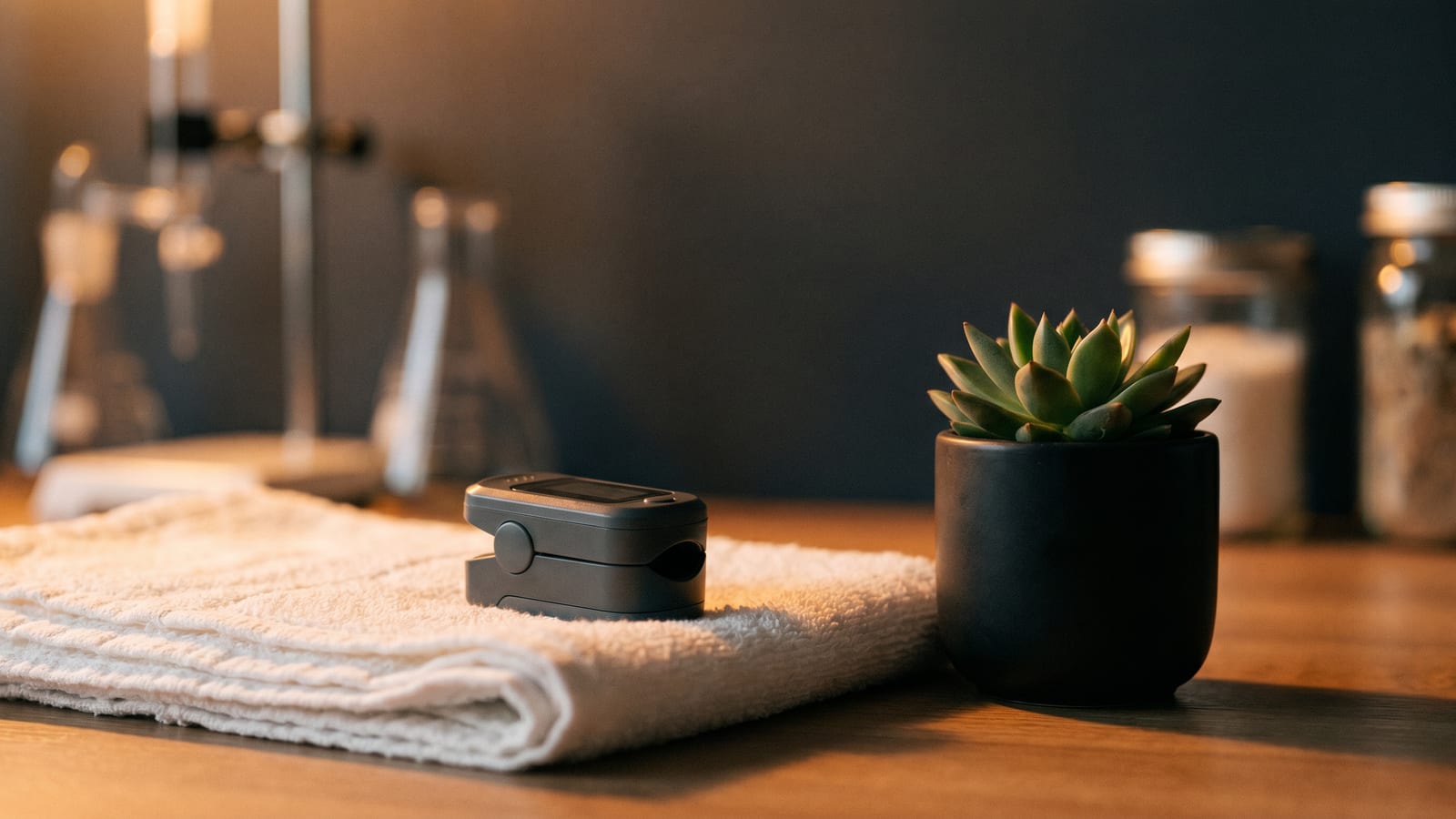
A blood oxygen monitor gives you a number in seconds. That number can either be genuinely useful or a source of pointless anxiety, depending on how you interpret it. This article covers what SpO2 actually measures, where consumer devices fall short, and how to use the data without spiraling every time your wrist-worn tracker flashes 94%.
What Is a Blood Oxygen Monitor and How Does It Work
A blood oxygen monitor, technically called a pulse oximeter, measures SpO2: the percentage of hemoglobin in your blood that is carrying oxygen. Normal hemoglobin can either be bound to oxygen (oxyhemoglobin) or not (deoxyhemoglobin). SpO2 tells you what fraction is in the oxygenated state.
The measurement works through a principle called photoplethysmography. The device shines two wavelengths of light through your tissue, typically red (around 660 nm) and infrared (around 940 nm). Oxygenated and deoxygenated hemoglobin absorb these wavelengths differently. By comparing absorption ratios, the sensor calculates SpO2.
This is different from PaO2, which is the partial pressure of oxygen dissolved in arterial blood. PaO2 comes from an arterial blood gas test, which is an invasive lab measurement. SpO2 and PaO2 correlate well at normal ranges, but they diverge at lower saturations. SpO2 is a proxy, not a direct measurement.
Pulse oximeters read from extremities like fingertips, earlobes, or the wrist because these areas have superficial capillary beds where light can pass through tissue. Fingertip devices clamp over the nail bed, where perfusion is consistent and the tissue is thin enough for the light to penetrate cleanly.
What Is a Normal Blood Oxygen Level
Clinically, a normal SpO2 is 95-100%. Most healthy adults at sea level sit at 97-99% at rest. A reading of 95% is technically within range but warrants attention if it’s sustained or represents a drop from your personal baseline.
Below 95%, the clinical picture sharpens. A reading in the 90-94% range is mild hypoxemia. Below 90% is clinically significant and typically requires medical evaluation. Below 85% constitutes severe hypoxemia.
A single reading, though, is nearly meaningless in isolation. One 93% reading during a bout of mouth breathing while lying on your side is not the same as sustained 93% overnight. Trend matters far more than snapshots.
Clinical red flags: if you’re experiencing symptoms like shortness of breath, confusion, rapid heart rate, or cyanosis (bluish tint in lips or fingertips) alongside low SpO2, that is a medical situation, not a biohacking data point. Seek care.
One important limitation: SpO2 cannot detect carbon monoxide poisoning. CO binds to hemoglobin at the same sites as oxygen, and pulse oximeters cannot distinguish between the two. Your SpO2 reading can appear normal even as you’re being poisoned.
SpO2 also tells you nothing about:
- Anemia (low total hemoglobin; you can have normal saturation with dangerously low hemoglobin)
- Metabolic acidosis (blood pH problems unrelated to oxygen saturation)
- Tissue oxygen utilization (whether your cells are actually using the oxygen being delivered)
It measures saturation, not the full picture of oxygen delivery or utilization.
Consumer vs. Clinical Pulse Oximeters
The FDA requires medical-grade pulse oximeters to be accurate within plus or minus 2% compared to arterial blood gas reference measurements. Consumer wearables typically fall in the 4-5% range under ideal conditions, and accuracy drops further in low-perfusion states, cold extremities, or during movement.
Skin tone is a documented accuracy problem. Multiple studies have found that pulse oximeters systematically overestimate SpO2 in people with darker skin tones, often by 2-4%. This is a hardware calibration issue rooted in how devices were validated historically, largely on lighter-skinned populations. The FDA has acknowledged this and is actively revising standards. If you have darker skin, your readings from consumer devices warrant extra skepticism.
Motion artifact is another real limitation. Any movement can introduce noise into the signal. Readings taken during exercise or when you’re fidgeting are often unreliable. This applies especially to wrist-worn devices, which have weaker signal to begin with.
Fingertip oximeters generally outperform wrist-worn devices because the finger provides better perfusion, less motion during a sitting measurement, and a cleaner light path. For serious tracking, a fingertip device wins on accuracy every time.
For clinical use, whether managing a respiratory condition, post-surgical monitoring, or altitude safety, a medical-grade fingertip device with FDA clearance is the right tool. For general biohacking trend tracking overnight or during daily life, a wearable is fine, as long as you don’t treat every reading as precise.
Blood Oxygen Monitoring for Sleep
Sleep is when SpO2 monitoring delivers the most value. During normal sleep, SpO2 dips slightly, particularly during REM. A 1-2% drop is typical and not concerning. What you’re looking for in the data are sustained drops below 90%, repeated desaturation events, or a pattern of low average nighttime SpO2.
Sleep apnea causes repeated episodes where breathing stops or becomes very shallow. Each episode typically produces a SpO2 drop, followed by a recovery. When you look at overnight SpO2 data, these show up as sawtooth patterns, repeated dips occurring every few minutes. This is not diagnostic (only a sleep study can diagnose sleep apnea), but it’s a reasonable flag that warrants further evaluation.
Devices like Oura Ring, Whoop, and Apple Watch all offer overnight SpO2 monitoring. Oura and Apple Watch use photoplethysmography sensors on the finger and wrist respectively. None of these are medical-grade diagnostic tools, but for trend tracking over weeks and months, they’re genuinely informative.
The useful way to use overnight SpO2: track your average and look for nights that are notably lower. If your typical average is 96% and you’re repeatedly seeing 92% averages after certain behaviors (alcohol before bed, sleeping on your back, heavy training days), that’s signal worth acting on.
Blood Oxygen and Altitude Training
Altitude changes the equation. As altitude increases, barometric pressure drops, so each breath contains fewer oxygen molecules. SpO2 falls as a result, triggering what’s called the hypoxic ventilatory response: your body increases breathing rate and depth to compensate.
At 3,000 meters (around 10,000 feet), most people see SpO2 in the 90-94% range. At 5,000 meters, it often drops to 80-88%, even with acclimatization. Tracking SpO2 during altitude ascent tells you how well your body is compensating.
Acclimatization takes days to weeks. As it progresses, SpO2 typically rises back toward baseline as your body produces more red blood cells and adapts breathing patterns. SpO2 tracking lets you see this process in real time.
The “live high, train low” protocol is a classic endurance training strategy: sleep and rest at altitude (or simulated altitude) to stimulate red blood cell production, but train at lower altitude to maintain workout quality. SpO2 helps you calibrate target altitude: you want enough hypoxia to stimulate adaptation (generally SpO2 in the 88-94% range during rest) without dropping so low that recovery is impaired.
Hypoxic tents and altitude chambers simulate this at home. Typical targets are 2,500-3,500 meters simulated altitude during sleep. SpO2 monitoring in this context is genuinely useful feedback, not just novelty tracking.
One counterproductive scenario: pushing training intensity at actual altitude before acclimatization. Your SpO2 may be low enough to impair performance and recovery without triggering obvious symptoms. If you’re at elevation and your SpO2 at rest is below 88%, back off training intensity until it stabilizes.
SpO2 Monitoring for Exercise and Recovery
During intense exercise, SpO2 in healthy individuals typically stays at or above 95%. A drop below 90% during exercise, called exercise-induced arterial hypoxemia, does occur in some elite endurance athletes due to diffusion limitations in the lungs at very high cardiac output. It’s not common, and consumer devices during exercise are often too noisy to accurately detect it anyway.
Post-exercise SpO2 is a different story. After heavy training, SpO2 should recover to your baseline within a few minutes. Prolonged depression of SpO2 after exercise could indicate incomplete recovery or respiratory stress, though this is more relevant in clinical populations than in healthy athletes.
As an overtraining signal, SpO2 alone is weak. Read it alongside HRV, resting heart rate, and subjective recovery scores instead. A single post-workout dip is meaningless. Sustained low nighttime SpO2 with rising resting heart rate and declining HRV over weeks is worth investigating.
SpO2 is not a primary metric for exercise performance. VO2 max, lactate threshold, power output, and heart rate tell you far more about fitness. Use SpO2 as a supporting data point, not the main variable.
Choosing a Blood Oxygen Monitor for Biohacking
For fingertip pulse oximeters, look for FDA clearance (for US buyers) or CE marking (Europe), an accuracy specification of plus or minus 2-3%, and a display that shows both SpO2 and pulse rate. The CMS-50 series devices are inexpensive and reasonably accurate for resting measurements. The Masimo MightySat is the clearest step up in the consumer fingertip space, with Masimo’s signal extraction technology, which handles low-perfusion and motion better than most.
For wearable SpO2, the major smartwatches (Apple Watch Series 9+, Garmin Fenix/Forerunner line, Samsung Galaxy Watch) and rings (Oura Ring) all offer overnight tracking. They’re convenient and give you trend data, which is the main value proposition.
Here’s a direct opinion: if sleep-tracking SpO2 is your primary use case and you want accurate data, a dedicated overnight fingertip oximeter (Wellue O2Ring, for example) will outperform any smartwatch. The wrist is a poor sensor location compared to the finger. If you’re already wearing a smartwatch for other reasons, its SpO2 data adds marginal value. But don’t buy a premium smartwatch primarily for SpO2 accuracy. A $40 fingertip device beats it.
How to Use SpO2 Data Without Overreacting
The most practical starting point is establishing your personal resting baseline. Measure SpO2 in the morning, before getting out of bed, consistently for a week. This gives you your baseline range. Most people land between 96-99%.
A meaningful change is a sustained drop of 3-4 percentage points from your baseline, sustained meaning not a single reading but a pattern over multiple nights or multiple resting measurements. One reading of 94% when you’re usually 98% is not cause for alarm. Five nights averaging 93% when you usually average 97% is worth investigating.
The anxiety problem with SpO2 monitoring is real. Consumer wearables generate data constantly, and normal physiological variation, motion artifact, and sensor noise all produce readings that look alarming without being clinically significant. Getting hyperfocused on individual readings is a fast path to unnecessary stress.
The rule: use trends, not single readings. Ignore movement-artifact readings. Establish your baseline first. Only act on sustained, symptomatic, or dramatically different data.
SpO2 monitoring is a useful tool when you know what you’re looking at. It’s not a substitute for medical evaluation when something is actually wrong, and it’s not a precision instrument in its consumer form. Used with calibrated expectations, it adds genuine signal to your health tracking stack.
Frequently Asked Questions
What is a dangerous blood oxygen level? Below 90% is clinically significant. Below 85% is severe. A brief 93% reading while asymptomatic differs from sustained readings below 90% with symptoms.
How accurate are smartwatch SpO2 readings? Typically within 4-5% under ideal conditions. Accuracy drops with movement, cold skin, darker skin tones, and low perfusion. Useful for trends, not point-in-time precision.
What causes low blood oxygen? Altitude, sleep apnea, respiratory conditions like asthma or COPD, pneumonia, pulmonary embolism, and heart failure are common causes. In healthy people, the most common causes of transient low readings are sensor placement, motion artifact, or cold extremities.
Can I use my Apple Watch to monitor blood oxygen? Yes, for trend tracking. Apple Watch SpO2 is wrist-based and inherits accuracy limitations at that location. It is useful for spotting patterns over time, particularly overnight trends, but not for medical-grade assessment.
Does altitude affect blood oxygen levels? Directly. SpO2 drops at elevation due to lower barometric pressure and recovers over days to weeks as acclimatization progresses.
How do I know if my pulse oximeter is accurate? Look for FDA clearance (or CE marking) and an accuracy specification in the device documentation. Cross-check against a medical-grade device if you have access. If your reading differs by more than 3-4% from a medical device under identical conditions, the consumer device is drifting.