How to Build a Longevity Stack: A Tiered, Evidence-Based Protocol
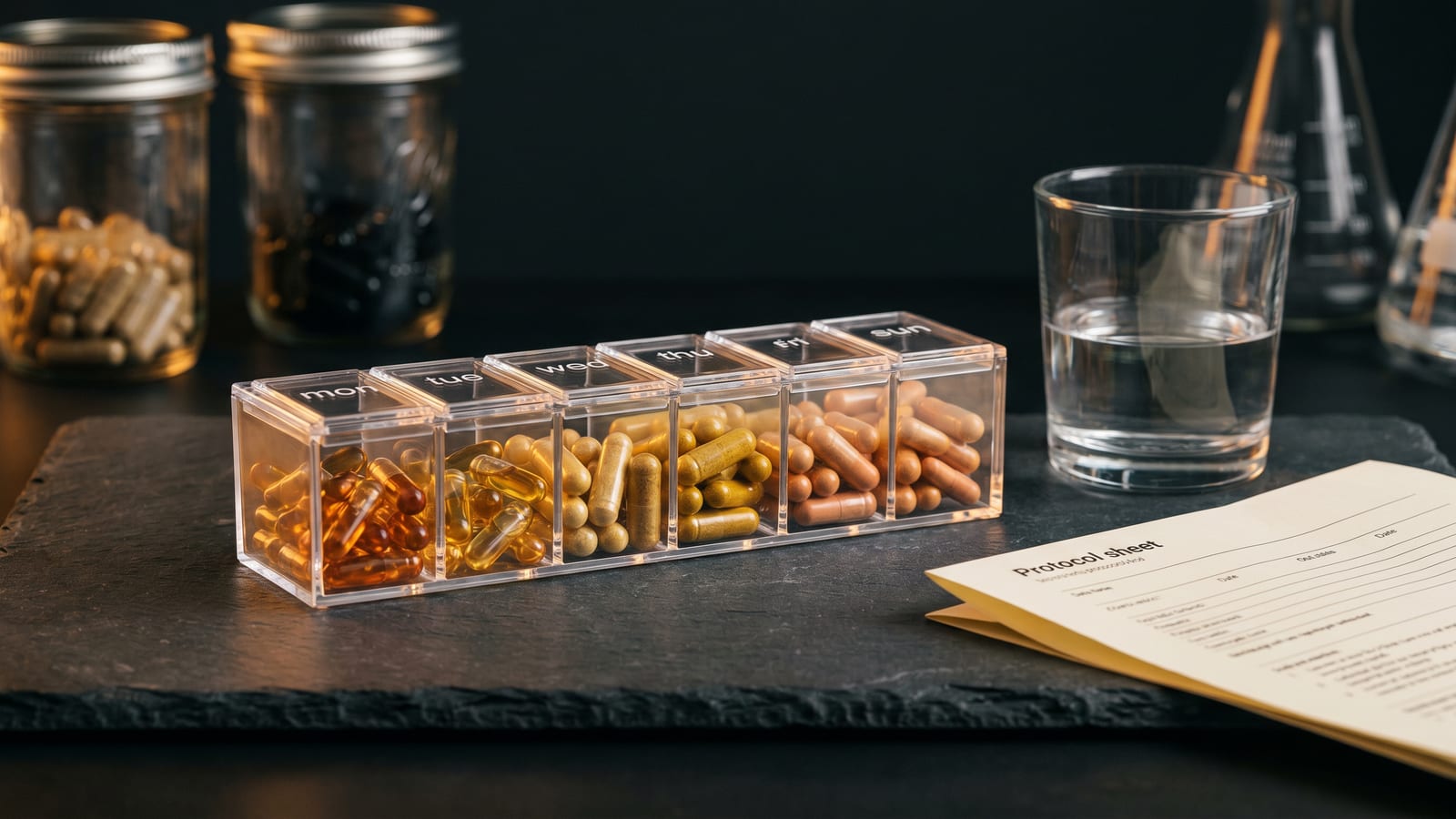
You’ve seen the protocols. Sinclair takes NMN and resveratrol. Bryan Johnson takes 100+ pills daily. The biohacking influencers all have their stack. What’s rarely explained is the actual reasoning behind it: which compounds target which mechanisms, why combining them is worth doing at all, and where the evidence actually runs out.
This guide is that explanation. Not a shopping list. A system.
The goal is to give you a framework for thinking about longevity interventions, so that whatever you add to your protocol has a rationale behind it, and whatever you skip, you skip on purpose.
What Is a Longevity Stack - And Why “Stack” Matters
A longevity stack is a set of interventions that together target multiple distinct aging mechanisms simultaneously. The word “stack” matters. A pile of supplements is not a stack.
The case for stacking comes from the biology. Aging is not caused by a single thing going wrong. Lopez-Otin’s hallmarks of aging framework identifies over a dozen interacting processes: accumulation of senescent cells, chronic low-grade inflammation (inflammaging), declining NAD+ and sirtuin activity, dysregulated mTOR and nutrient sensing, loss of proteostasis, mitochondrial dysfunction, and more.
No single compound addresses all of these. Metformin is powerful for metabolic regulation and mTOR suppression, but it does nothing to clear senescent cells. NAD+ precursors support sirtuin activity and DNA repair, but they don’t significantly affect autophagy. Senolytics reduce the senescent cell burden, but they won’t raise your NAD+ or improve insulin sensitivity.
A stack targets distinct pathways in parallel. That’s the actual logic. Not “more is more” but “different mechanisms, layered.”
The other thing a real stack has is an order of operations. Everything does not go in at once.
The Stack Hierarchy - What Gets Added in What Order
Think in three tiers. The order reflects safety profile, quality of human evidence, and reversibility. This is the most important thing to internalize before you buy anything.
Tier 1: The non-negotiables
These are not supplements in the exciting sense, but they do more per dollar spent than anything in Tiers 2 or 3. Skip them and the rest is noise.
- Exercise: Zone 2 cardio (3-4 hours per week) and resistance training are the highest-return longevity interventions with the clearest human evidence. This is not negotiable.
- Sleep: Consistently poor sleep accelerates every hallmark of aging. Seven to nine hours, consistent schedule.
- Diet: Whole food base, adequate protein (especially important over 40 for muscle preservation), caloric control.
- Omega-3: 1-2g EPA+DHA per day. The DO-HEALTH trial demonstrated cardiovascular, bone, and muscle benefits in older adults at this dose. One of the best-supported supplements in the space.
- Vitamin D: Widespread deficiency, especially in northern latitudes. Target serum levels of 40-60 ng/mL. Get tested before supplementing; most people need 2,000-4,000 IU daily to hold that range.
- Magnesium: Most people are insufficient. Supports sleep, glucose metabolism, and hundreds of enzymatic reactions. Glycinate or malate forms absorb better than oxide.
Tier 1 addresses fundamental physiology. It also tells you something about your discipline. If you can’t maintain consistent exercise and sleep, you won’t maintain the more complex protocol you’re building toward. Supplements amplify good foundations; they don’t create them.
Tier 2: Evidence-supported with caveats
These have decent human safety data and plausible mechanism. The longevity outcome data in healthy humans is thin, but the risk-benefit math is reasonable for most healthy adults.
- NAD+ precursors (NMN or NR)
- Creatine monohydrate (muscle preservation with age, cognitive support under metabolic stress)
- Metformin (with medical involvement; consider timing around training days if you are aerobically active)
- Berberine (lower-risk AMPK alternative to metformin)
Tier 3: Prescription only, medical supervision required
This tier has some of the most compelling animal data in all of longevity science and the most serious risk profiles.
- Rapamycin (intermittent low-dose)
- Dasatinib + Quercetin (senolytic protocol)
The hard line on Tier 3 exists for two reasons. First, these compounds affect immune function and wound healing at therapeutic doses. The margin between “potentially beneficial” and “causing real harm” is narrow and shifts based on your individual health status. Second, you need baseline labs to detect early problems and follow-up labs to catch issues before they compound.
NAD+ Precursors - NMN vs. NR and What the Evidence Actually Shows
NAD+ (nicotinamide adenine dinucleotide) declines significantly with age. This matters because it’s a cofactor for sirtuins, the proteins that regulate DNA repair, gene expression, and mitochondrial biogenesis. It’s also consumed by PARP enzymes doing DNA damage repair. Lower NAD+ means less capacity for all of this.
Both NMN and NR raise blood NAD+ levels. That part is established. The question is which is better for longevity purposes, and the honest answer is: we don’t know yet.
NR has the longer track record in human trials. Multiple published studies confirm it raises NAD+ in healthy adults, is well-tolerated, and doesn’t produce concerning side effects at standard doses (250-500mg). The evidence on longevity outcomes in humans is essentially absent, but the safety case is reasonable.
NMN has a theoretical advantage: it sits one step closer to NAD+ in the biosynthesis pathway. Some researchers argue this leads to more efficient uptake, particularly in tissue types that lack the enzyme to convert NR directly. The human safety data is more limited, and long-term human trials are sparse. The 250-500mg daily range is commonly cited.
A 2025 thorough review of NMN human trials confirmed there is no conclusive human lifespan or healthspan data in healthy adults for either compound. That’s not a reason to dismiss them, but it is a reason to hold your certainty loosely.
If you’re choosing: NR if you want the safer bet with more published human data. NMN if you want the compound with the theoretical uptake advantage and are comfortable with less certainty. Either way, sourcing matters. Look for third-party testing (NSF Certified, Informed Sport) because these compounds are expensive and frequently underdosed or contaminated.
mTOR Inhibition - Rapamycin, Metformin, and When Combining Is Too Much
mTOR (mechanistic target of rapamycin) is a nutrient-sensing kinase. When it’s active, the cell is in growth mode. When it’s suppressed, autophagy kicks in: the cell clears damaged proteins, dysfunctional mitochondria, and debris. With age, mTOR tends to stay overactive, autophagy declines, and cellular junk accumulates.
Suppressing mTOR intermittently is one of the most reproducible lifespan-extending interventions in animal models. The question is how to do it, at what cost.
Metformin activates AMPK, which suppresses mTOR indirectly. It’s a biguanide used for decades in type 2 diabetes, with a well-understood safety profile. The TAME (Targeting Aging with Metformin) trial is specifically testing whether it extends healthspan in non-diabetic older adults, making it the most carefully studied longevity compound in humans. Longevity-relevant dosing appears to be around 500mg per day, lower than typical diabetes dosing.
Here’s the trade-off you need to weigh. Metformin appears to blunt adaptations to aerobic exercise, specifically the mitochondrial biogenesis response you get from Zone 2 training. One RCT found that older adults on metformin got significantly less benefit from endurance exercise than the placebo group. If exercise is your primary longevity tool (and it should be), this is a real cost. Some practitioners time metformin away from training days. Others deprioritize it entirely for active individuals.
Metformin also complicates glucose monitoring. Because it lowers fasting glucose, it can mask insulin resistance developing beneath the surface. Get baseline glucose, HbA1c, and fasting insulin before starting, and recheck at 12 weeks.
Rapamycin is more potent. It’s a direct mTOR1 inhibitor, and in animal models it’s the most consistently life-extending pharmacological intervention ever tested. Weekly low-dose use (1-6mg, protocols vary) is what most longevity physicians prescribe off-label for healthy adults.
The risks are real and should not be minimized. Rapamycin is an immunosuppressant. At transplant medicine doses, it significantly impairs immune function. Whether weekly low doses do the same in healthy people is an open question, but impaired wound healing and elevated susceptibility to infections are documented concerns even at low doses. Fasting blood glucose tends to rise on rapamycin. Bryan Johnson, who built one of the most public longevity protocols in existence, dropped rapamycin specifically citing elevated blood glucose and infection susceptibility.
The combination question. Metformin and rapamycin both suppress mTOR through different pathways and are sometimes discussed as potentially additive. The honest answer is that combining them has not been studied in healthy humans. The combination’s effect on mTOR suppression could be over-suppressive rather than beneficially synergistic, and both carry independent metabolic risks. If you’re considering this, it requires physician oversight and active monitoring, not self-directed experimentation.
Berberine is worth considering as a lower-risk alternative for AMPK activation. It’s OTC, has reasonable human safety data, and produces modest effects on glucose metabolism and mTOR. The magnitude of effect is smaller than metformin, but so is the risk profile. A reasonable Tier 2 candidate for people who want metabolic pathway support without a prescription.
Senolytics - Clearing Senescent Cells and Why Timing Matters
Cellular senescence is one of the clearer aging mechanisms. Senescent cells have stopped dividing but refuse to die. They secrete a cocktail of pro-inflammatory cytokines and matrix-degrading enzymes called the SASP (senescence-associated secretory phenotype). This secretion promotes inflammation and encourages nearby healthy cells to become senescent too. Accumulation of these cells correlates with age-related disease across multiple organ systems.
Senolytics selectively induce apoptosis in senescent cells. They work best used intermittently, for a specific reason: the goal is to periodically clear the accumulated senescent burden, not to continuously suppress normal cellular processes. Chronic daily dosing is almost certainly wrong for this class of compound.
Fisetin is the most accessible senolytic. It’s a flavonoid found in strawberries, available OTC, with strong animal data and early-stage human trials showing senolytic activity. The protocol typically used is 20mg/kg body weight for two consecutive days, once per month. Human trial data is limited; most of what we know comes from animal models and in vitro work. Don’t interpret the animal data as proof of identical effects in humans, but the safety profile appears benign.
Dasatinib + Quercetin (D+Q) is the most studied senolytic combination. Dasatinib is a prescription cancer drug (tyrosine kinase inhibitor). Quercetin is OTC. Together, they cleared senescent cells in a human trial with idiopathic pulmonary fibrosis patients, which was a landmark result. The same intermittent protocol applies: two consecutive days monthly.
The catch is dasatinib. It’s a serious medication with real side effects including pleural effusion and cardiac events at oncology doses. Off-label use for longevity means you’re extrapolating from cancer patient data. Medical supervision is not optional here.
Two-days-per-month rationale: more frequent use may impair wound healing and immune function because senescent cells do play a role in normal tissue repair. This is not a case where more frequent dosing equals more benefit.
What to track once you start senolytics: skin healing time (slower healing is a warning sign), susceptibility to infections, and hs-CRP at baseline and 12-week intervals. These are rough proxies, but they give you something concrete to watch.
Building Your Longevity Stack - A Practical Process
The order matters. Here’s the process that makes sense.
Step 1: Get baseline labs before adding anything new.
Minimum panel: fasting glucose, HbA1c, fasting insulin, hs-CRP, full lipid panel, vitamin D (25-OH), liver function (ALT, AST), kidney function (creatinine, eGFR), CBC. This tells you where you’re starting and flags anyone who should not be adding certain compounds without physician clearance. Elevated fasting glucose plus wanting to add rapamycin is a conversation with a doctor, not a green light.
Step 2: Optimize Tier 1 for 90 days first.
This is not exciting, but it’s the most impactful step. If your sleep, exercise, and diet are not dialed in, adding NAD+ precursors will produce marginal results. Get Tier 1 working, then reassess.
Step 3: Add Tier 2 compounds one at a time.
One compound, six to eight weeks, then assess subjective response and recheck relevant labs at 12 weeks. Stacking multiple new things simultaneously makes it impossible to know what’s doing what, and harder to identify adverse reactions early.
Step 4: Audit your existing supplement use.
If you’re already taking quercetin for inflammation, that’s relevant to any senolytic protocol. If you’re on a high-dose multivitamin, check for overlap with Tier 1 additions. Polypharmacy risk is real and increases with age. If you’re on statins, antihypertensives, SSRIs, or anticoagulants, interactions need to be checked explicitly before adding anything in Tier 2 or 3.
Step 5: Tier 3 only with a physician involved.
Not as a formality. Because you need someone reading your labs, adjusting doses, and watching for the specific adverse effects that animal studies don’t prepare you for.
Who Should Build a Longevity Stack - and Who Should Wait
The risk-benefit math shifts depending on who you are.
Generally healthy adults over 40, with Tier 1 fundamentals in place and baseline labs done, are the right candidates for a thoughtful Tier 2 addition. Family history of metabolic disease, neurodegeneration, or cardiovascular disease shifts the risk-benefit further toward action.
Adults under 35 in good health should wait. Your natural resilience and recovery capacity are high. The marginal benefit from pharmaceutical-grade mTOR suppression is low, and suppressing growth-related pathways during peak anabolic years carries costs that aren’t well-characterized yet. Fix your fundamentals and revisit at 40.
Anyone already on immunosuppressants should not add rapamycin or senolytics without careful medical review. People who haven’t fixed sleep and exercise yet should not be adding Tier 2 compounds. Supplements amplify good biology; they don’t create it.
One last thing worth saying: the longevity clinic space has grown fast, and not all of it is rigorous. Clinics that prescribe rapamycin or peptides without baseline labs and follow-up monitoring are not practicing careful medicine, regardless of how scientific their marketing sounds. A good longevity protocol starts with measurement, adds compounds systematically, and watches closely for what changes.
Build the system. Measure what matters. Update based on what you see.