Creatine for Longevity – What the Evidence Actually Shows
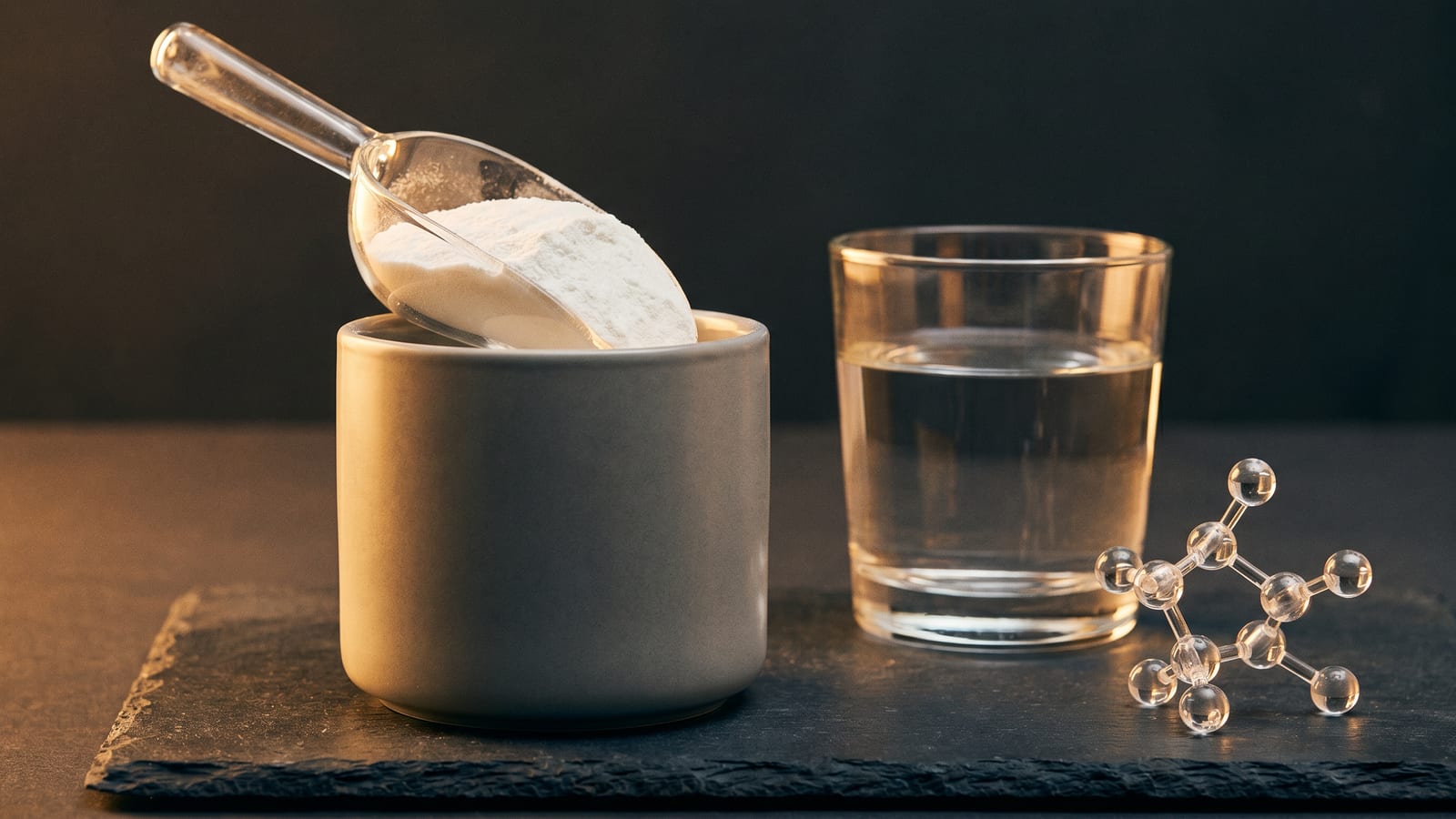
Creatine has spent decades being treated as a gym supplement for people who want bigger biceps. That’s underselling it. At its core, creatine is a cellular energy substrate, one that your body produces in declining quantities as you age and that supports the same biological systems that fail first in aging: muscle, brain, and mitochondria.
You don’t need to be lifting weights for this to matter to you. Sarcopenia, the progressive loss of muscle mass, starts in your 30s. Cognitive energy metabolism degrades even earlier. If you’re thinking about long-term health, creatine deserves a serious look well before you turn 60.
This article covers what creatine does mechanistically, what the aging-specific evidence actually supports, and how to use it practically.
What Creatine Is and Why It Matters for Longevity
Creatine is a compound synthesized in the liver, kidneys, and pancreas from the amino acids arginine, glycine, and methionine. About 95% of it lives in skeletal muscle; the remaining 5% is distributed in the brain, heart, and testes.
Your natural production declines with age, and dietary sources (primarily red meat and fish) don’t compensate unless you’re eating substantial quantities daily. This means most adults are operating at sub-optimal creatine stores, and older adults more so.
The longevity angle isn’t about creatine being some anti-aging molecule in the rapamycin or senolytics sense. It’s simpler: creatine supports the cellular energy systems that degrade first in aging. If those systems stay healthier longer, you lose muscle more slowly, think more clearly, and recover better. That’s worth taking seriously.
How Creatine Works – Energy, Methylation, and Aging
Creatine’s primary mechanism is well-established. In muscle and brain cells, creatine accepts a phosphate group from ATP (your primary cellular fuel molecule) to become phosphocreatine. When energy demand spikes (a hard set of squats, rapid neural firing, a moment of acute cognitive load) phosphocreatine donates that phosphate back to ADP to regenerate ATP almost instantly.
Think of phosphocreatine as a fast-discharge battery for cellular energy. The oxidative (aerobic) system is your grid power: efficient but slow. The phosphocreatine system handles peak demand, bridging the gap until slower energy pathways catch up.
Why does this matter more as you age? Muscle mitochondria become less efficient with age (mitochondrial dysfunction is one of the hallmarks of aging), so oxidative ATP production slows. A robust phosphocreatine buffer partially compensates. The brain, which consumes roughly 20% of total body energy at rest, also sees declining energy metabolism with age. Creatine’s role in brain ATP buffering isn’t a secondary benefit; it’s directly relevant.
There’s a second, less-discussed mechanism the longevity community has started paying attention to. Creatine synthesis requires methyl groups donated by S-adenosyl methionine (SAM), the same SAM that regulates DNA methylation across the genome. Creatine synthesis consumes an estimated 40% of all SAM methyl groups in the body. As endogenous creatine production declines with age, this may disrupt the DNA methylation patterns that govern epigenetic aging. 2025 NHANES analysis identified correlations between lower creatine availability and accelerated epigenetic aging, though causality isn’t yet established.
This methylation connection is hypothesis-generating, not settled science. But it’s why the longevity conversation has expanded well beyond muscle.
The Evidence Hierarchy – What Research Actually Shows
The mistake most articles make is treating all creatine benefits as equally supported. They aren’t. Here’s the honest breakdown.
Muscle Mass and Sarcopenia – Strong Evidence
This is where the evidence is strongest. The 2019 Candow meta-analysis (226 citations) found that creatine supplementation in adults 50+ combined with resistance training produces significantly greater lean mass retention than training alone: approximately 1.1–1.5 kg additional lean mass in men, 0.5–0.6 kg in women over a typical trial period.
That’s not a trivial number. When sarcopenia affects 30% of adults over 60 and up to 50% of adults over 80, preserving lean tissue isn’t an aesthetic question; it’s a functional one. Falls, mobility, metabolic health, and all-cause mortality risk are all tied to how much muscle mass you carry into your later decades.
The mechanism is partly energy substrate (more capacity for high-intensity effort), partly anabolic signaling (creatine appears to stimulate satellite cell activation and muscle protein synthesis), and partly cellular hydration.
Does it work without resistance training? Modest effects on muscle markers have been observed, but lifting is doing most of the work. Creatine amplifies training; it doesn’t replace it.
Bone Density – Moderate Evidence
Less discussed than muscle, but real. Combined creatine and resistance training in older adults improves bone mineral density markers and reduces fall risk compared to training alone. The mechanism is partly indirect: more muscle strength means more mechanical loading on bone, which drives bone formation. The evidence is moderate: meaningful, but thinner than the muscle data.
Brain and Cognitive Function – Promising, Preliminary
The evidence here is real but requires precision. In older adults, creatine supplementation consistently shows improvements on memory and processing speed tasks. A 2024 meta-analysis found significant cognitive benefits across adults 18–60; the data for those over 60 is less consistent.
A 2025 Alzheimer’s pilot trial is generating real interest: 20g/day of creatine produced an 11% increase in measured brain creatine levels. The implication is that higher doses may be needed to saturate brain tissue. Muscle is greedy and sequesters creatine first. This is why brain-focused research uses 10–20g doses rather than the standard 3–5g range. Whether this translates to meaningful protection against Alzheimer’s progression is an open question.
Animal data: a 2004 study found creatine reduced brain lesion volume by 83% in rodent models of neurological insult. That’s striking. It’s also animal data, which routinely fails to translate. Treat it as hypothesis-generating.
Don’t expect a noticeable cognitive boost if you’re 30 and eat a normal omnivorous diet. Expect more if you’re older, sleep-deprived, or habitually plant-based.
Lifespan Extension – Mechanistic Only
A 2008 mouse study found creatine supplementation extended healthy lifespan by approximately 9% (equivalent to roughly 7+ human years) and reduced brain lipofuscin, a cellular waste marker associated with aging. This is the most dramatic finding in the creatine-longevity literature.
It’s also the most cautious one to interpret. Mouse lifespan studies don’t reliably predict human outcomes; that’s the uncomfortable reality of aging research. No long-term longevity RCTs exist in humans. The anti-aging framing for lifespan is inferential: creatine preserves things (muscle, cognition) that are associated with healthspan, but association is not a causal chain.
File this under “intriguing and hypothesis-generating,” not “proven.”
Who Benefits Most
Not everyone gets the same return from creatine. The benefit is amplified by certain circumstances.
Adults 50+: The clearest beneficiaries for muscle and bone effects. The RCT evidence is concentrated in this population.
Post-menopausal women: Women produce roughly 70–80% less endogenous creatine than men and typically have lower dietary creatine intake from meat. Post-menopausal estrogen decline further suppresses creatine synthesis. This population may have the most to gain from supplementation, yet is dramatically underrepresented in the research base. The existing evidence, including Candow 2019’s female-specific data, supports creatine combined with resistance training for preserving both muscle and bone.
Vegetarians and vegans: No dietary creatine from meat means lower baseline muscle stores. Studies consistently show vegetarians responding more strongly to supplementation. There’s more headroom to fill.
Sleep-deprived individuals: Sleep deprivation depletes brain creatine stores. Creatine supplementation appears to buffer the cognitive decline associated with sleep loss, particularly for tasks requiring short-term memory and complex problem solving. If you’re chronically short on sleep, this is an underappreciated angle.
Anyone doing resistance training: Creatine amplifies all benefits. Without exercise, you’re leaving most of the effect on the table.
How to Use Creatine for Long-Term Health
Form: Creatine monohydrate. That’s it. Creatine HCl, creatine ethyl ester, and buffered creatine cost more and perform the same or worse in head-to-head trials. Anyone selling you a “superior” form is selling you margin, not efficacy.
Dose by goal:
- Muscle and bone: 3–5g/day maintenance. Well-tolerated and sufficient for saturating muscle stores over four weeks.
- Brain and cognitive effects: 10–20g/day. Muscle tissue sequesters creatine before the brain gets its share. Higher doses are needed to achieve meaningful brain saturation. Spread across 2–4 doses to reduce GI load.
- No loading phase required for either goal. Loading (20g/day for 5–7 days) reaches saturation faster but causes more GI disturbance and doesn’t improve long-term outcomes. If you want faster results, load. If not, steady dosing works fine.
Timing: Largely irrelevant. Post-workout shows a marginal edge in some trials, but consistency matters far more. Put it wherever it fits your routine.
Caffeine interaction: The concern that caffeine blunts creatine uptake is not supported by current evidence. Take them together without worry.
Who should be cautious: Anyone with pre-existing kidney disease or a single kidney should consult a physician first. Creatine increases creatinine in blood tests. This is a metabolic byproduct of creatine use, not kidney damage, but it can trigger false alarms on standard kidney panels if your doctor isn’t aware you’re supplementing.
Risks and Who Should Skip It
Creatine monohydrate has a strong safety record in healthy adults. Decades of trials in athletic and clinical populations haven’t found meaningful harm in people with normal kidney function.
The caveats are real but specific:
- Kidney disease: Don’t self-prescribe. In compromised kidney function, the metabolic burden is a real risk.
- Bipolar disorder: There’s a signal (case series and at least one RCT) that creatine may trigger manic episodes in people with bipolar disorder. The mechanism likely involves creatine’s effects on brain energy metabolism. If you have a bipolar diagnosis, discuss this with a psychiatrist before starting.
- Supplement quality: Creatine is largely unregulated as a dietary supplement. Use a brand that tests for heavy metal contamination. Creapure-certified products are a reliable benchmark.
- Bloating/GI: Mild bloating in the first week or two is common. It passes. Taking creatine with food helps. At higher doses (10–20g), spreading doses throughout the day is important.
Frequently Asked Questions
Is creatine a steroid? No. It’s an amino acid derivative produced naturally by the body and found in food. It has no androgenic activity, is not a controlled substance, and is legal in all competitive sports organizations. The confusion comes from gym culture associating it with performance enhancement; the biology is completely different.
Does creatine cause hair loss? The concern stems from a single 2009 rugby trial that found elevated DHT (a hormone linked to androgenic hair loss) in creatine users. The study hasn’t been replicated, and no trials have found actual hair loss as an outcome. The evidence for this risk is weak. If you have significant family history of male pattern baldness and are anxious about it, monitor it. But the science doesn’t support treating this as an established risk.
Do you need to cycle creatine? No. Cycling is a holdover from early supplement culture. There’s no evidence of tolerance, suppression of endogenous production, or any benefit to cycling. Take it continuously.
Will creatine make me gain fat? No. Initial weight gain is water retention in muscle tissue, typically 1–3 lbs in the first few weeks. This is not fat; it’s increased intramuscular water, which itself signals growth pathways. If the scale moves up when you start creatine, that’s expected and benign.
Can older women take it? Yes, and they may benefit most. Post-menopausal women face accelerated muscle loss from estrogen decline plus lower baseline creatine production. RCTs show creatine combined with resistance training preserves bone density and lean mass more effectively than training alone in this population.
Does it affect kidney blood markers? Yes, it raises creatinine. That’s expected and benign in healthy people. If you’re getting a standard metabolic panel, tell your doctor you’re supplementing. An elevated creatinine in someone taking 5g/day of creatine monohydrate does not mean kidney damage. Context matters.
How long before I notice effects? Muscle saturation takes approximately four weeks at 3–5g/day (faster with a loading phase). Structural changes (lean mass retention, functional strength) build over months. Cognitive effects at higher doses may appear sooner, particularly under conditions of sleep deprivation or energy stress.