Indoor Air Quality – The Biohacker's Guide to Cleaner Air
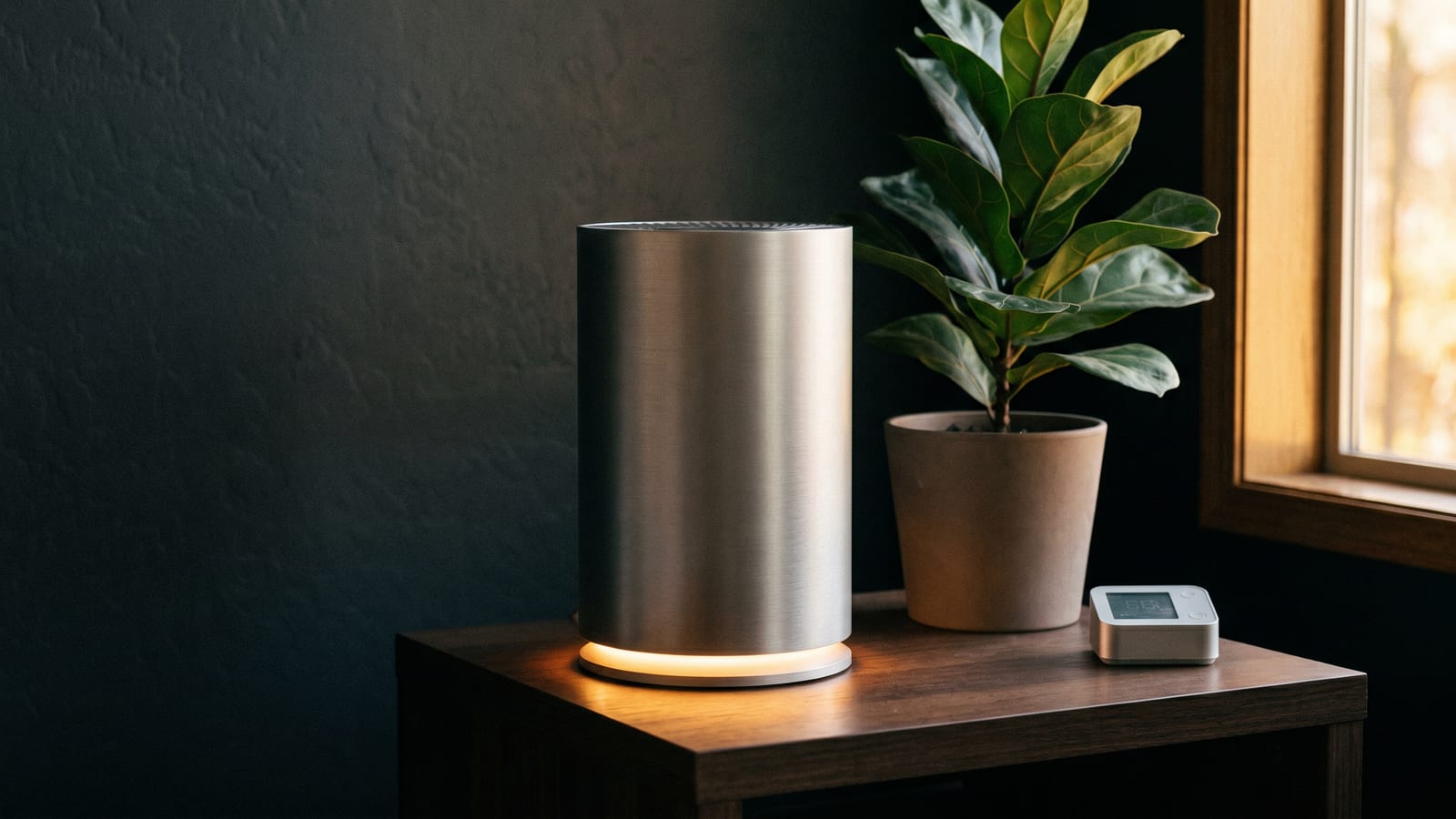
Most people think of indoor air quality as a lung issue: dust, allergens, asthma. That’s part of it. But the more relevant angle for biohackers is what air does to your brain. CO2 accumulation alone can measurably impair your thinking before you notice a single physical symptom, and you’re breathing indoor air for most of your life.
Why Indoor Air Quality Matters for Biohackers
You spend somewhere north of 90% of your time indoors. Office, home, car, gym. Most of that time, you have almost no idea what you’re breathing.
The cognitive angle is where this gets interesting. CO2 is not toxic at typical indoor levels, but research from Berkeley’s Center for the Built Environment found significant impairment in decision-making and strategic thinking at 1000ppm, with decline starting somewhere around 800-1000ppm. A typical office, meeting room, or bedroom with poor ventilation hits that range routinely. You’re not gasping. You’re just slightly less sharp, slightly more sluggish, and attributing it to a bad night’s sleep or too much coffee.
Sleep is the other major pathway. PM2.5 and CO2 buildup in a sealed bedroom affect sleep architecture and how rested you feel in the morning. This isn’t speculative. The mechanisms are well-documented even if the popular health conversation mostly ignores them in favor of mattresses and sleep trackers.
If you’re optimizing your diet, training, light exposure, and sleep schedule while breathing stale, particulate-laden air for eight hours a night, you’re leaving real gains on the table.
The Main Indoor Air Pollutants
CO2. Outdoor baseline sits around 420ppm. Typical indoor spaces land between 800-1200ppm. Where people sleep and work in closed rooms, it’s often higher. CO2 itself isn’t toxic at these levels, but the functional impairment is real and well-documented. Sources are simple: breathing, cooking, combustion, and poor ventilation.
PM2.5. Fine particulate matter, 2.5 microns or smaller. These particles get deep into the lungs and cross into the bloodstream. Indoors, the main sources are cooking (gas stoves are a significant contributor), candles, incense, and outdoor infiltration. Frying anything on a gas stove can spike indoor PM2.5 to levels you’d see in heavily polluted cities.
VOCs. Volatile organic compounds off-gas from furniture, paint, flooring, cleaning products, and synthetic fragrances. New furniture and carpets off-gas heavily for the first few weeks. “Air fresheners” are a net negative: they add VOCs rather than removing anything. VOCs are hard to measure precisely with consumer equipment, but they’re worth tracking directionally.
Radon. Colorless, odorless, and the second leading cause of lung cancer in the US after smoking. It infiltrates from the ground and accumulates in lower levels of buildings. Most people never test for it. A $15-30 kit from a hardware store will tell you what you’re dealing with.
Mold and humidity. Above 60% relative humidity, mold and dust mite growth accelerates significantly. Below 30%, mucosal membranes dry out, respiratory irritation increases, and you’re more susceptible to airborne pathogens. The optimal window is 40-60%.
Carbon monoxide. Acute danger from combustion appliances: gas stoves, furnaces, fireplaces, attached garages. A CO detector is non-negotiable if you have any combustion source in your home. This is not biohacking territory; it’s basic safety.
What to Actually Measure
CO2 is the most actionable metric by far. It’s easy to measure accurately, it changes quickly in response to ventilation changes, and the target is clear: below 800ppm for sharp cognitive work, below 600ppm is excellent.
PM2.5 is worth tracking in kitchens and bedrooms. An AQI below 12 indoors consistently means you’re in good shape. Above 35 regularly, you have a problem worth addressing.
VOCs are harder. Most consumer monitors give a generic TVOC number that’s directionally useful but not chemically precise. Use it to detect spikes (someone just sprayed cleaner, new furniture arrived, you burned something on the stove) rather than as an absolute health metric.
Temperature and humidity complete the picture. For sleep, 65-68F (18-20C) is the well-supported target. Humidity in the 40-60% range keeps your mucosa happy and discourages mold.
On monitors: the Aranet4 is the standard recommendation for CO2. It uses an NDIR sensor, which is accurate to within 50-75ppm. Most cheap CO2 monitors use electrochemical sensors and are not reliable. For PM2.5 and VOCs, the Awair Element or Temtop M2000C cover the bases reasonably well. You don’t need everything at once. An Aranet4 plus a budget PM2.5 monitor covers about 80% of what’s worth knowing, for well under $300 combined.
How to Improve Indoor Air Quality
Ventilation is first. Open windows when outdoor AQI is good (below 50). This is the most effective and cheapest intervention available. The failure mode is opening windows during wildfire smoke, high pollen days, or when you’re near high-traffic roads with peak pollution. Check a local AQI app first. This takes five seconds.
HEPA air purifiers. Look for CADR (Clean Air Delivery Rate) matched to your room size. A CADR of 200+ covers most bedrooms and offices up to around 400 square feet. Larger rooms need proportionally higher CADR. The number matters more than the brand.
Activated carbon filters. HEPA removes particles. It does nothing for gases or VOCs. If VOCs are a concern (new furniture, renovation, gas cooking), you need a purifier with both a HEPA layer and an activated carbon layer. Check that the carbon is actually a substantial filter, not a thin pre-filter sheet with a few grams of carbon sprinkled on it.
Humidity management. A good hygrometer tells you where you stand. Below 30%, a humidifier helps. Above 60% consistently, you need a dehumidifier. In dry climates or during winter heating season, low humidity is the more common problem.
Source control. This is the highest-impact long-term move and the most underrated one. Low-VOC paints and finishes when you’re renovating. No synthetic air fresheners, ever. Natural cleaning products. Let new furniture off-gas in a garage or well-ventilated space for a week before bringing it inside. You can run an air purifier 24 hours a day and still have high VOC levels if you’re constantly adding new sources.
The Bedroom Optimization Protocol
A closed bedroom with one or two people sleeping will accumulate CO2 over the course of a night. By morning in a well-sealed room, CO2 can easily hit 1500-2000ppm. That’s not a crisis, but it’s meaningfully higher than where your brain performs best, and it correlates with worse sleep quality.
The fix is simple. Crack a window one to two inches. Even in winter, the thermal cost is minimal compared to the ventilation benefit. If outdoor air quality is poor overnight (check), run a HEPA purifier with the window cracked rather than closed.
Target bedroom temperature: 65-68F (18-20C). The evidence for this being favorable for sleep onset and sleep quality is solid. Cooler than this starts to interrupt sleep. Warmer, and most people have a harder time staying asleep.
Keep a CO2 monitor in your bedroom for a week. Check what it reads when you wake up. If it’s above 1200ppm, you need more ventilation. This single data point often surprises people more than any other air quality measurement they take.
A portable HEPA purifier running on a low continuous setting is the minimum viable bedroom setup if you’re serious about sleep quality. It’s not glamorous. It works.
Air Quality and Wildfire Smoke
When outdoor AQI exceeds 150, outside air is worse than inside. This inverts the usual calculus. Close windows, seal gaps with tape if the event is severe, and rely entirely on filtration.
For wildfire smoke specifically, you need True HEPA (not “HEPA-type” or “HEPA-like”) plus activated carbon. Wildfire smoke contains both PM2.5 and VOCs, and you need both filter types to address it.
The “Corsi-Rosenthal box” is worth knowing about. It’s a DIY air purifier: a box fan plus a MERV-13 or HEPA-rated furnace filter taped together. Studies during wildfire events have shown it performs comparably to commercial air purifiers for PM2.5 removal at a fraction of the cost. It’s not a permanent solution, but it’s genuinely effective for acute smoke events.
If a major smoke event hits, pick one room, close it off, and run the highest-CADR purifier you have in there. One clean room is better than trying to filter an entire house at lower efficiency.
Do Houseplants Actually Help?
The “plants clean your air” idea traces back almost entirely to a 1989 NASA study done in sealed chambers with pollutant concentrations far higher than any real home environment. The study was designed to inform space station air quality. It’s been misapplied to homes ever since.
Real-world estimates suggest you’d need several hundred plants per room to achieve the VOC removal that a basic air purifier handles in minutes. Plants do produce small amounts of oxygen and remove trace quantities of some VOCs, so the effect isn’t literally zero. But it’s not meaningful as an air quality intervention.
Get plants if you like plants. A snake plant in the corner is not doing anything measurable for your CO2 or VOC levels. Don’t confuse having a nice living space with having good air quality.
Risks and Limitations
Monitor obsession is a real failure mode. Watching CO2 numbers throughout the day produces anxiety more reliably than it produces insight once you’ve already characterized your space. Measure for a week, identify your problem areas and thresholds, then set up simple triggers (CO2 above 800ppm, crack a window) and stop staring at the numbers.
Consumer monitor accuracy has real limits. NDIR CO2 monitors are reasonably accurate within about 50-100ppm. That’s good enough to act on. PM2.5 laser particle counters are directionally correct but not lab-grade. Don’t make fine-grained health decisions based on 10ppm CO2 differences or small variations in PM2.5 readings.
TVOC readings from consumer monitors vary so much between devices that direct comparisons are unreliable. Use them to spot spikes and identify sources, not as absolute numbers. A related issue: that “new car smell” or “new furniture smell” is not a sign of freshness. It’s volatile compounds off-gassing, and the cumulative load from multiple new products in a sealed space can produce meaningfully elevated VOC levels for weeks. The fix is dilution: ventilation and time.
When to bring in professionals: radon testing (a hardware store kit works well, a certified tester is more precise), and any mold situation that goes beyond surface level. If you smell mildew consistently, or see mold recurring despite cleaning, that’s a structural moisture problem requiring assessment, not a filter problem.
Frequently Asked Questions
What CO2 level impairs cognition? Research from Berkeley’s Center for the Built Environment shows meaningful impairment in decision-making and strategic thinking above 1000ppm. Decline starts around 800-1000ppm. Keep your workspace below 800ppm.
Do air purifiers help with sleep? Yes, particularly in bedrooms with outdoor pollution infiltration or where allergies are a factor. Reduced particulate load means less nasal irritation, clearer airways, and better breathing overnight.
How often should I replace HEPA filters? Manufacturers typically say 6-12 months. In high-pollution environments or with continuous heavy use, check the filter at 6 months. Pre-filters should be cleaned monthly. A clogged pre-filter significantly reduces the efficiency of the main HEPA stage.
Are cheap air quality monitors accurate enough? For CO2: only if they use NDIR sensors. Mid-range devices like the Aranet4 or anything built on the SCD40 sensor chip are reliable. Cheap electrochemical CO2 sensors are not. For PM2.5, budget monitors are useful for direction and spikes but not precise measurements.
Can I just open windows? Yes, when outdoor AQI is below 50. Check your local AQI app before opening. During wildfire smoke, high pollen season, or near high-traffic roads at peak hours, opening windows may worsen indoor air quality.
What’s the minimum viable home office air setup? An NDIR CO2 monitor (Aranet4 or equivalent) and a HEPA plus activated carbon air purifier sized for your room. Budget around $250-400 total. Add a habit: when CO2 crosses 800ppm, open a window or turn up the purifier. That’s it.