Red Light Therapy for Recovery: What the Science Actually Says
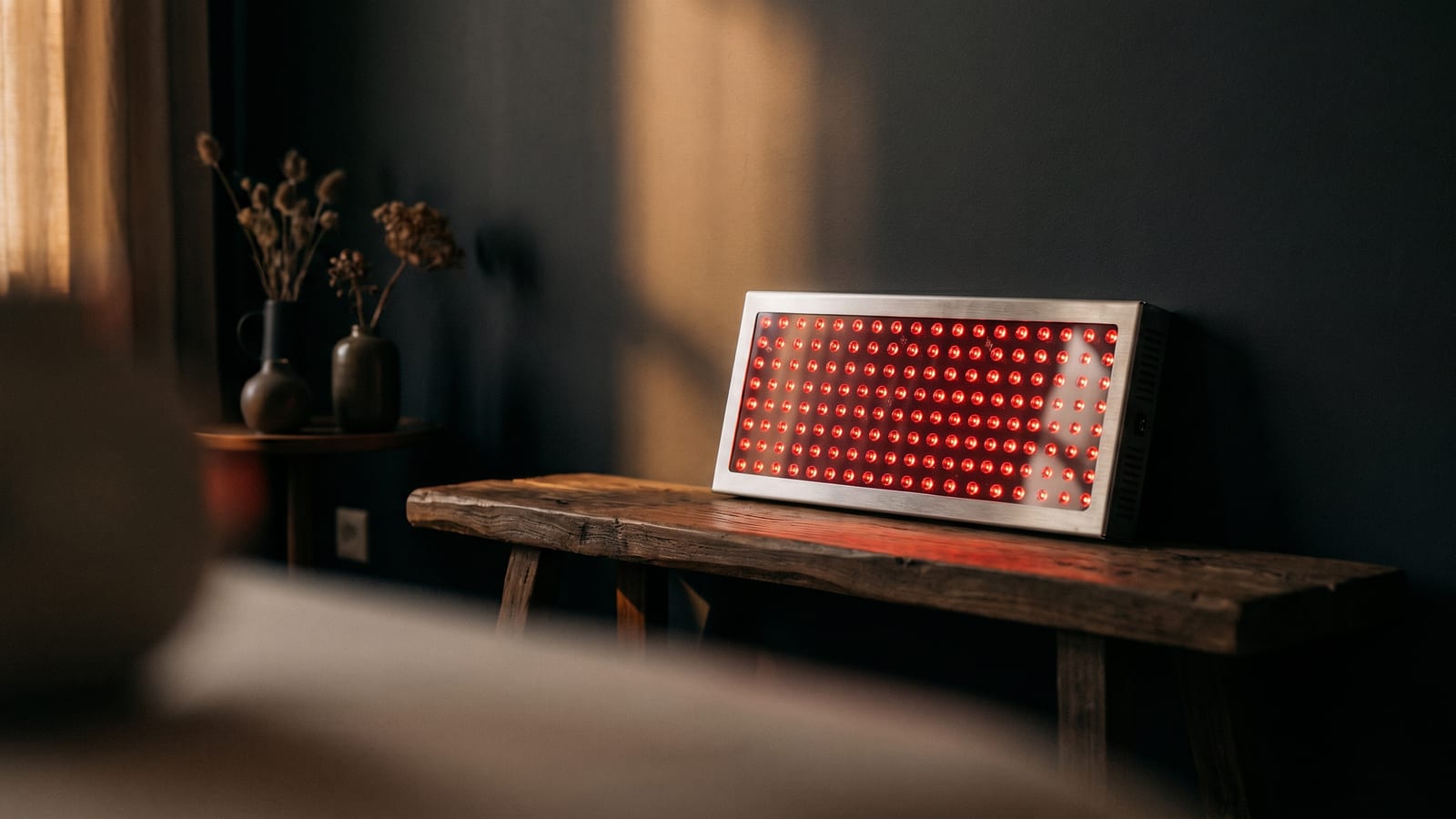
Red light therapy has moved from fringe biohacking circles to mainstream fitness in about five years. That speed of adoption is worth interrogating, because the hype curve for this stuff has outpaced the science by a significant margin. The devices are real. The mechanism is real. The effect sizes are, in most cases, modest.
What Is Red Light Therapy and Why Should You Care About Recovery?
Photobiomodulation (PBM) is the clinical term. It describes the use of specific wavelengths of visible red and near-infrared light to produce biological effects in tissue, without heat and without UV radiation. Those two caveats matter: this is not a sunbed, and it does not work through warmth.
Two wavelength ranges dominate recovery applications:
- Red light (630-660 nm): penetrates skin to roughly 5-10 mm. Reaches superficial tissue, dermis, and the top layer of muscle.
- Near-infrared (NIR, 810-850 nm): penetrates to 30-40 mm. Gets into muscle belly, joint tissue, and bone.
Recovery is the actual constraint for most serious training. You can train hard, but can you absorb that training fast enough to do it again? Any intervention that accelerates muscle repair, reduces inflammation, or blunts delayed onset muscle soreness has real competitive value, even if the effect is a 10-15% improvement rather than a miracle.
How Red Light Therapy Works (The Recovery Mechanism)
The primary target is cytochrome c oxidase, a protein complex inside the mitochondrial inner membrane that functions as the final electron acceptor in the electron transport chain. This is where your cells actually make ATP.
When red or NIR light hits that protein, it appears to dissociate nitric oxide that has been inhibiting it. Nitric oxide competitively binds to the same site as oxygen. Knock it off, and the cell can produce ATP more efficiently. More ATP means more cellular energy available for repair processes.
From there, several downstream effects have been documented:
- Reduced reactive oxygen species (oxidative stress)
- Increased nitric oxide release into surrounding tissue (vasodilation, improved blood flow)
- Upregulation of heat shock proteins
- Activation of transcription factors (NF-kB, AP-1) that regulate inflammation and cellular repair
The key thing to understand is that this is a signaling effect, not a direct energy delivery. The light modulates the cell’s own machinery. That distinction explains both the dose-dependence and the modest effect sizes in human trials.
What the Research Says on Recovery
The research base is real but uneven. Here’s what’s solid and what’s oversold.
DOMS reduction. The most consistent finding in the literature. Baroni et al. (2010) showed in a double-blind RCT that pre-exercise PBM applied to the quadriceps reduced DOMS at 24 and 48 hours post-exercise compared to sham treatment. Leal Junior et al. (2010) replicated the effect in a volleyball player cohort. Effect sizes typically run 20-30% reduction in soreness scores, meaningful not transformative.
Muscle repair and protein synthesis. Ferraresi et al. (2011) demonstrated increased muscle torque and reduced creatine kinase (a biomarker of muscle damage) following PBM in a resistance-training study. Ferraresi et al. (2012) followed up with evidence for upregulated gene expression related to protein synthesis and satellite cell activation. Satellite cells are the stem cells of skeletal muscle, getting them active faster matters for recovery.
Performance recovery. Leal Junior et al. (2009) showed that PBM before a fatigue protocol improved the number of repetitions to fatigue in a bicep curl test. De Marchi et al. (2012) found that post-exercise PBM accelerated restoration of isometric peak torque compared to placebo.
Honest assessment of the evidence. Most trials are small (n=10-30) and skewed toward young, healthy male subjects. Many come from groups with industry ties or manufacturer funding, not disqualifying but worth noting. Protocol heterogeneity makes meta-analyses messy. Leal Junior et al. (2015) produced one of the better systematic reviews and concluded that PBM does improve recovery markers, but emphasized that optimal parameters remain undefined.
Bottom line: the signal is real, the effect sizes are modest, and anyone claiming dramatic results is out ahead of the data.
Wavelengths, Dosing, and Session Timing
Getting this wrong is the most common failure mode for people who “tried red light and it didn’t work.”
Wavelengths for recovery: Red (630-660 nm) handles superficial tissue and is fine for skin-level inflammation and surface soreness. NIR (810-850 nm) is the better choice for muscle recovery and joint tissue because of the penetration depth. Most dedicated recovery panels deliver both simultaneously, which is the sensible approach.
Power density. The parameter that most devices underreport or misrepresent. You want 20-100 mW/cm² at the treatment surface. Below 20 mW/cm² and sessions become impractically long. Above 100 mW/cm² with extended duration you start hitting the inhibitory range of the biphasic dose response curve.
Energy dose targets. Research protocols cluster around 3-50 J/cm² delivered per session. For muscle recovery specifically, Ferraresi and Leal Junior protocols tend to use 10-20 J/cm² per treatment site. At 50 mW/cm², that’s 3-7 minutes of exposure per area.
Session frequency. 3-5 sessions per week during active training blocks. More than once daily provides no additional benefit in most protocols and risks tipping into the inhibitory zone.
Timing: pre vs. post-workout. Pre-workout PBM appears to reduce muscle damage acutely and slightly improve performance output. Post-workout PBM aids in clearing inflammation and accelerating repair. Both approaches show benefit in the literature; the choice depends on your primary goal. If you are managing training volume over a competitive season, pre-workout makes sense. If you are already sore and trying to recover faster, post-workout is the call.
Choosing a Device for Recovery Use
This is where the biohacking market gets genuinely predatory. Devices span from $60 LED arrays with no clinically relevant output to $1,500 panels from reputable manufacturers.
What actually matters:
Irradiance output at treatment distance. This is the only number that tells you whether the device will produce an effect. Ask for mW/cm² at 6 inches and at 12 inches. Reputable manufacturers publish these figures. Budget devices that claim “200W” are measuring LED input wattage, not usable output at your tissue.
Wavelength accuracy. The active wavelengths should be within 10 nm of the stated spec. Cheaper manufacturers cut corners here. Third-party spectrometer data is ideal; some review sites (PlatinumLED, Joovv) have been independently tested.
Panel size. A 12x6 inch panel can treat a single limb. Treating your whole back or both legs simultaneously requires a larger panel (24x12 or full-body).
FDA clearance. Means the device passed a 510(k) pathway, essentially demonstrating safety and substantial equivalence to a predicate device. It does not mean the FDA evaluated clinical efficacy. Cleared means safe and legally saleable, not a performance guarantee.
Budget tiers:
- Under $200: Limited options with verified irradiance. Mito Red Light MitoMIN and a few Bestqool panels hit minimum viable specs. Verify before buying.
- $200-500: Best value range. RedRush 300, Mito Red MitoMID, and comparable mid-panels from Hooga deliver documented irradiance. Good for single-zone treatment.
- $500+: Full-body panels from PlatinumLED (BioMax series), Joovv, and Kineon’s modular systems. Worthwhile if you are using this seriously and treating large muscle groups.
Risks and Who Should Skip It
The safety profile is favorable, but there are real contraindications.
Eye damage. Direct exposure to high-irradiance red or NIR light can cause photochemical retinal damage. Always use protective eyewear rated for the relevant wavelengths. This is not optional.
Skin sensitivity and medications. Photosensitizing drugs (certain antibiotics, NSAIDs, antidepressants, chemotherapy agents) significantly increase phototoxicity risk. Check your medications before starting.
Absolute contraindications:
- Active skin cancer or history of melanoma in the treatment area
- Eye diseases including retinal disease, glaucoma, or cataracts (consult ophthalmologist first)
- Direct irradiation over active hemorrhage
- Photosensitizing drug regimens without physician clearance
Pregnancy. Data is simply absent. There are no adequate human studies. Avoidance of direct abdominal treatment is the conservative position.
Biphasic dose response. More is not better. The Arndt-Schulz principle applies here: low doses stimulate, high doses inhibit. Studies by Huang et al. (2009) formalized this for PBM. Exceeding recommended doses does not accelerate results, it attenuates them. Stick to protocols with established J/cm2 targets.
How to Fit It Into Your Recovery Stack
Red light therapy does not conflict with most other recovery modalities, but there are some pairing considerations.
Cold plunge (cold water immersion). Cold and PBM work through different mechanisms and can be stacked the same day. Post-workout cold, then PBM 2-3 hours later is a reasonable sequence if you are doing both.
Sauna and heat. Avoid same-session pairing with cold. Heat and cold alternated within hours may blunt each other’s hormetic effects. PBM pairs fine with heat; just do not layer them back-to-back.
Sleep quality. Some users report improved sleep quality with evening PBM sessions, possibly through nitric oxide-mediated effects on circadian signaling. This is weakly evidenced but consistently reported anecdotally. Avoid red light within 30 minutes of bed if you are sensitive to light exposure at night.
Training blocks vs. deload. During hard training blocks (high volume, high frequency), daily PBM has the clearest justification. There is actual damage to repair. During deload weeks, backing off to 2-3 sessions per week makes sense. Do not use it as a substitute for adequate sleep and nutrition; it is an adjunct, not a foundation.
Frequently Asked Questions
How long before I notice a difference? Two to four weeks of consistent use (3-5x/week) is the realistic expectation for observable changes in recovery speed and soreness. Acute sessions can blunt DOMS in the following 24-48 hours.
Can I use it every day? Yes, at appropriate doses. Daily use above established J/cm2 parameters starts working against you.
Is near-infrared better than red light for recovery? For muscle and joint recovery, yes. NIR penetrates to the tissue depth where most recovery happens. Red light is fine for superficial soreness and skin-level work. A panel with both wavelengths is the practical choice.
Do cheap devices work? Some do, most don’t. The question is whether the device delivers sufficient irradiance at treatment distance. A $100 panel that hits 40 mW/cm² at 6 inches is more useful than a $150 panel that delivers 8 mW/cm². Look for third-party irradiance measurements, not wattage claims.
Does it help with injury recovery? There is decent evidence for tendinopathy (Bjordal et al., 2008, showed clinically significant improvement in Achilles tendinopathy) and some inflammatory conditions. Evidence for structural damage (ligament tears, muscle fiber rupture) is sparse. PBM works best for managing inflammation and accelerating cellular repair, not for regrowing damaged tissue.
Red light therapy is a legitimate recovery tool with a real mechanism and real (if modest) evidence. Use it consistently, dose it correctly, protect your eyes, and don’t let the hype outpace what the studies actually show. At current device prices, it clears the cost-benefit threshold for serious athletes. For casual exercisers, that calculus is closer.